12x and 24x, in plain English.
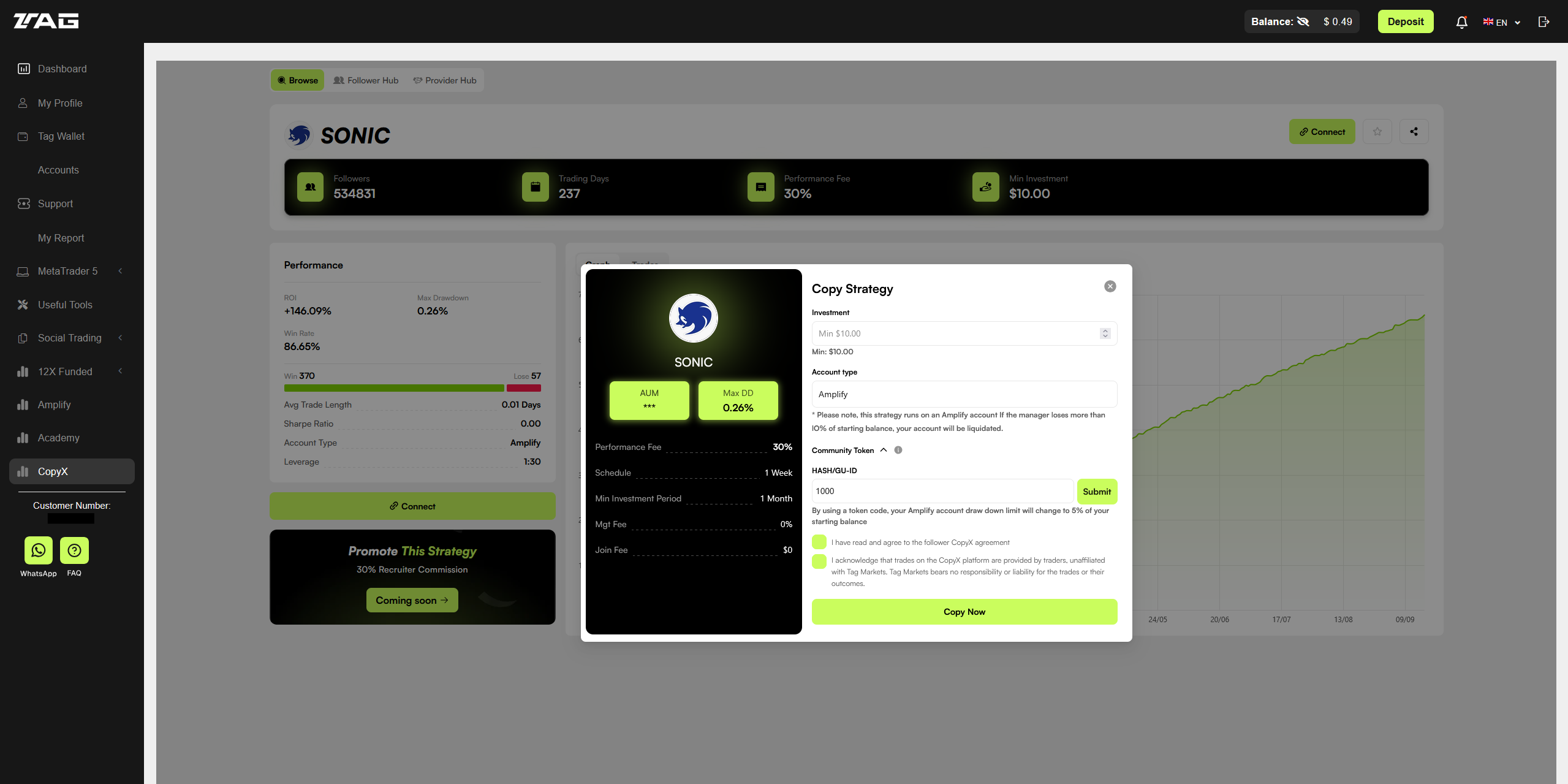
The community token is part of the 24x setup we have used. First, understand what amplified trading capacity changes—and what it does not.
01What amplification is
Trading capacity, not withdrawable cash
Amplify scales your trading capacity beyond your deposited balance. The amplified portion sizes positions — it isn’t money you can cash out directly, and it is not customer funds held on your behalf.
| Check | Copying a strategy | Amplify 12x | 24x option |
|---|---|---|---|
| What it means | Mirroring new strategy trades | Additional trading capacity | A higher tier used in the publisher’s community-token setup |
| Availability | Check your account and strategy | Advertised by Tag Markets | Confirm eligibility directly |
| Withdrawal rules | Depend on the account used | 30-day deposit wait; withdrawing initial capital closes the account | Confirm the applicable terms |
| Loss rules | Your account bears losses | 10% drawdown limit on the starting balance | 5% once a community token is entered |
02The documented tier
The publicly documented tier
- A static 10% drawdown limit calculated on your account’s initial balance — your deposit, not the amplified trading capacity (equity/floating loss).
- Profits are withdrawable at any time.
- Your original deposit is locked for 30 days from your first trade.
- Upgrading the account with profit can restart that 30-day window.
- Instrument-specific charges and leverage are separate from the amplification multiple. Check current trading conditions ↗.
03What the token changes
Twice the capacity.
Half the room to lose.
Entering a community token does two things at once, and only one of them is the reason people enter it. Most guides describe the first and stop.
12x
No token needed
- A $100 deposit trades as
- $1,200
- Drawdown limit
- 10% of starting balance
- Which on $100 is
- $120
24x
Community token entered
- A $100 deposit trades as
- $2,400
- Drawdown limit
- 5% of starting balance
- Which on $100 is
- $120
Calculated on the full amplified total, not the raw deposit — see the callout below for the Tag Markets article that describes it this way, and the other one that doesn’t.
Source
See Tag Markets’ own Amplify page for the official terms.
04Reaching 24x
How accounts reach it in practice
GoldCopyGuide has used the community-token setup for 24x. You can find the token, GU/ID and where to enter them in the setup guide. The provider’s public Amplify page describes 12x; confirm the complete conditions of your 24x account directly with Tag Markets.
What still isn’t published
The 5% figure comes from the platform dialog, not from a published tier document. Eligibility, charges, withdrawal conditions and what happens to open positions are still not set out anywhere public. Confirm all of them with Tag Markets, and treat 24x as unconfirmed for your account until they answer in writing.
Higher trading capacity can increase loss exposure. The actual outcome depends on sizing and account rules; do not assume that a tier label predicts a fixed return or loss. Read the risks.
Continue to CopyX ↗05Useful terms
A few useful terms
- Allocation
- The amount you assign to a strategy.
- Master / follower
- The strategy account and the separate account copying its new trades.
- Drawdown
- A decline from a previous account peak. Check whether a figure measures balance or equity, including open positions.
- Amplified balance
- Trading capacity above your deposit. The extra capacity is not cash you can withdraw.
- Drawdown limit
- The loss against your starting balance that closes the account. Published as 10% for 12x; the Copy Strategy dialog states 5% once a community token is used. A tighter limit is not a smaller loss — it is less room before the position is closed for you.
- A-book / B-book
- Two broker models. An A-book broker passes orders to the market and earns from spread or commission. A B-book broker takes the other side of the trade itself, so a client loss is broker revenue. Which model applies decides whether your broker has a stake in your outcome. Which one applies here